
Back in May 2024, the gacha sphere erupted with a new challenger: Kuro Game’s Wuthering Waves. At launch, the comparisons to HoYoVerse’s Genshin Impact were as inevitable as a Paimon snack break. Both were vast open‑world action RPGs, both had anime‑styled characters, both asked you to wish upon a banner and pray to the RNG gods. The initial verdict from many professional gamers (including the ever‑opinionated scribblers here) was a resounding “just play Genshin Impact instead, at least for now.” But 2026, dear traveler, is a whole different era. Two years of updates, patches, and community therapy sessions have reshaped the landscape. So, should a savvy gamer still cling to Teyvat, or has the Wuthering Waves ship finally caught the wind?
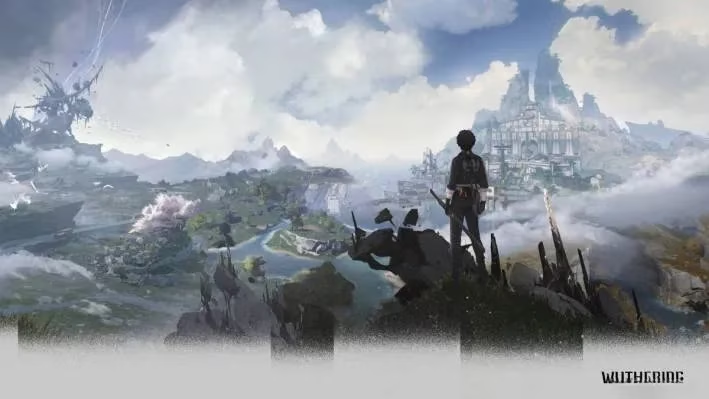
Let’s rewind first. The original critique was fierce: the gameplay loop was essentially identical to Genshin Impact—explore a stunning world, collect characters, beat up monsters with flashy combos, gacha for more characters, repeat. Wuthering Waves even shared the “you’re a stranded outsider with a mystery” trope, though mercifully it avoided the amnesia cliché (small victories). Yet, many of its launch zones felt like a remix of Mondstadt with slightly edgier lighting. The echo system—capturing defeated enemies to use their abilities—was a neat twist on the artifact/weapon grind, but it couldn’t mask the feeling that you’d climbed this very same hilichurl tower before in another game. Fast‑forward to 2026, and Kuro Game has sculpted those rough edges into something genuinely distinct. With the 3.0 update adding the floating continents of Celestial Verge, the exploration now relies heavily on verticality and mid‑air grapple mechanics that make gliding look like a casual stroll. Players can chain wall‑dashers, aerial combat strings, and echo‑dash platforms to traverse gaps that would make a Mondstadt cliff blush. If Genshin Impact’s exploration is a gentle hike with a scenic picnic, Wuthering Waves has become a parkour fever dream on a trampoline. It’s still not a clone; it’s a gymnast cousin doing backflips.
🗣️ The Localization Lament: From Awkward to Articulate
One of the loudest howls in 2024 was aimed at Wuthering Waves’ translation. The localization was so stiff you could use it as an ironing board. NPCs barked lines like “Have you confirmed the inventory? What about the spare list? Sort out the consumables as soon as possible.” Major characters delivered gems such as “Practice is better than words” and the unforgettable “please be reluctant to leave city grounds without authorization.” Players reported that skipping dialogue wasn’t a quality‑of‑life feature—it was a survival instinct. The early positive impressions that praised the skip button were a red flag the size of a Stormterror.
Thankfully, Kuro Game listened. By version 2.1 in late 2025, a massive localization overhaul had rewoven the text. The awkward phrasing was replaced with prose that actually sounds like human beings talking. The voice direction also got a polish; emotional scenes no longer sound like a robot reading a grocery list. While a few lines still smell faintly of machine‑translation ghost, the overall experience now rivals the rich, flavor‑packed writing of HoYoVerse. Genshin Impact remains the gold standard for localized charm—every region sparkles with cultural nuance, puns, and heartfelt stories—but Wuthering Waves has closed the gap from “unbearable” to “let me read every dialogue box.” That alone is a triumph.
⚔️ Combat & Character Carnival: Where Wuthering Waves Steals the Show
If there’s one arena where Wuthering Waves has always held an ace, it’s the combat core. Even at launch, the fluidity of swapping between three active characters, triggering echo skills, and executing aerial juggles felt tighter than a Fatui purse. In 2026, the roster has swollen to over 50 playable Resonators, each with unique mechanics that reward skill expression. The parry system, which originally felt like a gimmick, now underpins high‑end content: perfect dodges refill your echo meter, and a well‑timed deflection can stagger bosses into a 5‑second vulnerability window. Compare that to Genshin Impact’s elemental reaction dance—still delightful, but increasingly dependent on specific team templates (you will use National, and you will enjoy it). Wuthering Waves gives players more freedom to blend melee, ranged, and transform‑into‑a‑giant‑blue‑wolf styles without being handcuffed to a strict rotation.
Power creep, the eternal gacha specter, has been managed decently. The launch characters like Jiyan and Yinlin are still viable in endgame domains, though newer 5‑stars bring flashier movesets. Kuro Game’s approach of giving early units significant buffs in patch 2.3 and adding an “Evolution Matrix” system (think constellations but earnable through challenging Echo Challenges) has kept veteran squads relevant. Meanwhile, Genshin Impact’s power curve gently slopes upward with each new archon, but the imbalance is kept in check by the sheer flexibility of reactions. Both games now demand you build a roster breadth rather than chase a single hyper‑carry, but Wuthering Waves encourages more hybrid builds, making the teambuilding sandbox feel wider.
🎰 Gacha Generosity & Quality of Life
Comparing gacha economies is like measuring whose wallet bleeds slower. At launch, Wuthering Waves was stingy: few free pulls, a convoluted pity system, and a beginner banner that felt more like a goodbye banner. Fast‑forward to 2026, and the situation has brightened. Daily waveplates now overflow with enough energy to farm two full echoes without wanting to uninstall. The standard banner now lets you select a specific weapon after 200 pulls, and limited event banners carry over pity seamlessly—a direct nod to Genshin Impact’s system. Free 4‑star selectors rain during festivals, and the “Rover’s Journey” permanent pass gifts a full 5‑star character of your choice after 120 hours of gameplay.
Genshin Impact, ever the veteran, still hoards its freebies like Primogems are ancestral heirlooms. The anniversary rewards have become more generous since the 2024 debacle, but you’ll still need the patience of Zhongli to save for your desired waifu or husbando. The pity system is nearly identical now—hard pity at 80/90, 50/50 chance—so neither game has a clear edge. However, Wuthering Waves’ weapon banners don’t require a separate Fate Point grind; they’re guaranteed at 80 pulls with no split feature. For low‑spenders and dolphins, that’s a hefty advantage.
🌏 Worldbuilding & Content: The Infinite Expansion
In 2024, the world of Wuthering Waves felt promising but sparse. By 2026, the map has tripled in size, with zones that rival Sumeru’s rainforest in complexity and Fontaine’s underwater domains in atmosphere. The new “Mirage Shores” area, released with version 2.8, introduced dynamic weather that alters enemy behavior and unlocks hidden routes—a living ecosystem that makes static Teyvat feel a tiny bit museum‑like. Side quests now branch with multiple endings, and the main story has finally shed its amnesia‑adjacent clichés for a gripping tale of fractured timelines and Resonator consciousness.
Yet Genshin Impact’s world is still the master of environmental storytelling. Every stone in Liyue hums with history, every graffiti in Sumeru hints at ancient academia. The sheer volume of lore—from the Archon War to the Heavenly Principles—is staggering. Wuthering Waves is catching up fast, but Teyvat remains the Tolkienesque giant of the genre. If you want a world that feels lived‑in for ten years, Genshin Impact is the choice. If you want a world that feels like a futuristic playground with a glitching matrix, Wuthering Waves is your jam.
🧭 The Pro Gamer’s 2026 Roadmap: Which to Start?
So, the pressing question: should a fresh player in 2026 dive into the new hotness or the immortal classic? The answer, as always, is “it depends.” But after 800+ hours in both (yes, we’ve touched grass, occasionally), here’s a pithy breakdown:
| Factor | Wuthering Waves (2026) | Genshin Impact (2026) |
|---|---|---|
| Combat Fluidity | ★★★★★ – Aerial combos, parries, echo shenanigans | ★★★★☆ – Elemental reactions, slower but tactical |
| Story Quality | ★★★★☆ – Improved, now engaging and coherent | ★★★★★ – Rich, emotional, deeply woven |
| Localization | ★★★★☆ – Major overhaul, mostly smooth | ★★★★★ – Gold standard, occasional typos only |
| F2P Friendliness | ★★★★☆ – Better weapon banner, more free selectors | ★★★☆☆ – Stingy but stable, generous with patience |
| Exploration Joy | ★★★★★ – Fast, vertical, creative movement | ★★★★☆ – Serene, puzzle‑heavy, delightful hidden nooks |
| Endgame Modes | ★★★★☆ – Roguelike domains, raid‑style Echo Trials | ★★★☆☆ – Spiral Abyss, card game, occasional event |
If you’re just stepping into the gacha open‑world, Genshin Impact remains the safest bet. Its onboarding is smoother, its lore is immediately inviting, and you won’t get lost in a menu of echo transmutations. But if you’re a veteran of the genre looking for a faster, more mechanical challenge, Wuthering Waves has blossomed into a beast that finally deserves the spotlight—no longer the awkward little brother, but a rival in its own right. Heck, play both. Your stamina system will judge you, but we won’t.
In the end, 2026’s landscape proves that a shaky launch need not define a live‑service game. Wuthering Waves took the early punches, apologized with crystals, and iterated until its wings grew. Genshin Impact, meanwhile, continues to be the unshakeable titan, now expanding into anime and collaborations that keep it in the public eye. The pro gamer verdict? Give Wuthering Waves your afternoon, and Genshin Impact your weekend. May your 50/50s always land, and your echo substats roll double crit.