
Every player in Wuthering Waves eventually asks the same question: why does one Echo setup produce a small number while another with seemingly less ATK hits much harder? Even as new Resonators, Echo sets, and endgame modes arrive through 2026, the underlying damage math still follows a clear three-stage pipeline: the skill hit, the expected hit, and the final hit after enemy defenses. Understanding those layers makes it much easier to compare builds, choose Echoes, and improvise when an account lacks a recommended weapon.

The First Layer: ATK and Skill Multipliers
ATK is the foundation of nearly every damage calculation. A character's final ATK combines the character's base ATK and weapon ATK, applies the total percentage bonus from all sources, and then adds flat ATK bonuses. This is why an Echo with flat ATK can feel useful early, while percentage ATK becomes more valuable as base stats grow. Attack bonuses can appear as main stats or sub stats on almost any Echo, sometimes both at once.
The other primary factor is the skill multiplier found in the Forte tab. Clicking a skill shows an efficiency ratio, and that ratio determines how much of the final ATK is applied to that move. For example, Rover's Spectro Resonance Skill has a specific multiplier that rises as the ability is leveled, up to roughly double its base percentage at rank 10.
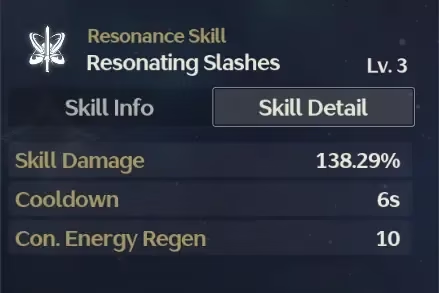
Some nodes, such as Encore's third Resonance Chain or Yinlin's first Resonance Chain, grant bonus scaling. These effects alter the skill's base ATK multiplier directly and multiply the skill's scaling before additive bonuses are considered. That distinction matters, because bonus scaling can outperform a similar-looking damage bonus if a player is already stacking many additive buffs.
Elemental and Skill Type Bonuses
Elemental DMG Bonus is the first layer of secondary damage increases. It boosts all damage of the matching element, including damage from the equipped top-most Echo. These bonuses appear on 3-Cost Echoes, Sonata effects, and certain Outro skills. In Wuthering Waves, all sources of elemental damage bonus are added together. A stat called 'DMG Bonus of all Resonance Attributes' is simply a universal elemental damage boost, not a separate multiplier.
Skill type bonuses work the same way. Effects worded as 'Basic Attack DMG Bonus' or 'Resonance Liberation DMG Bonus' apply only to that move type, but when they activate, they are additive with elemental damage bonus and each other. Does that mean a 30% skill bonus and a 30% elemental bonus behave like a 60% total bonus? Yes, but only when both apply to the same hit.
Deepen Effects
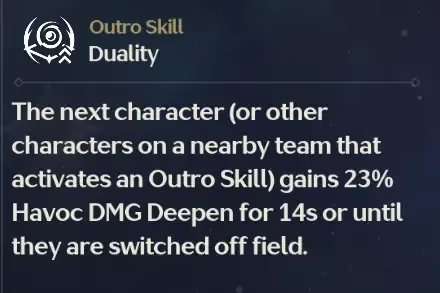
Deepen is one of the least clearly explained modifiers in the game. In practice, it is another multiplier that increases outgoing damage, but it has two major caveats. First, Deepen is mostly applied through character Outro skills, which forces a rotation-focused playstyle. Second, the effect can be highly specific.
Danjin's Outro, for example, boosts all Havoc damage for the next character switched in. Sanhua's Outro boosts basic attack damage regardless of element. The more specific the condition, the larger the boost tends to be. Players who ignore Deepen are leaving damage on the table, especially in team rotations.
Critical Hits and the 1:2 Balance
Critical hits multiply damage based on critical damage. Both crit rate and crit DMG can appear as main stats on 4-Cost Echoes, and either can appear as a sub stat on any Echo. A practical target is roughly 1% crit rate for every 2% crit DMG, while remembering that the stat screen already includes the base 100% crit damage. So the actual bonus is whatever number appears minus 100%.
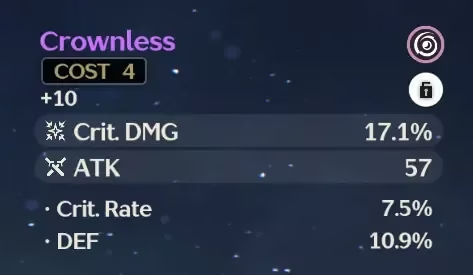
There are two major exceptions to the 1:2 rule. First, if crit rate reaches 100%, extra crit rate gives no benefit. Second, if a character receives temporary crit buffs during a burst window, the build should account for those buffs instead of only looking at the stat screen.
Enemy Defense and Resistance
The first damage reduction layer is enemy DEF. Against enemies in the same level bracket, the DEF modifier reduces incoming damage by roughly half. Data suggests an average of about 52% damage reduction, fluctuating between roughly 49% and 53%. Each level bracket difference changes the modifier by about 2%, which becomes especially relevant from SOL3 Phase 4 onward.

Enemy elemental resistance is the next layer. If an enemy resists an element, incoming damage of that type is reduced by about 33.3%. Most enemies in the Data Bank list their resistances. However, resistance can be reduced into negative values, making it act as a damage multiplier. For example, Rover's Spectro sixth Resonance Chain can lower resistance. Because resistance changes are additive with each other, a small shred can be more impactful than it first appears.
Damage Per Hit Versus DPS
A single hit tells one story; sustained damage tells another. Damage per second, or DPS, requires knowing the total damage of a full combo and the time that combo takes. The calculation is theoretical because real runs include missed inputs, boss movement, dodges, and many other variables.
For example, suppose a Spectro Rover lands three basic attacks and one jump attack over three seconds. If the total damage is 133 + 170 + 71 × 5 + 236, the sum is 894. Divide that by three seconds and the theoretical DPS is 298. That is a simplified example, but it shows the method.

Diminishing Returns and Multiplicative Stacking
Why does stacking one stat too heavily feel inefficient? If a character has 500 base ATK and gains 100%, the total becomes 1,000. Adding another 100% brings the total to 1,500, which is only a 50% increase over the previous 1,000, despite costing the same amount of build space. That is diminishing returns in action.
The smarter approach is to spread bonuses across different multiplier categories. A 30% boost added twice within the same category produces a 60% damage increase. But a 30% elemental damage bonus combined with a 30% Deepen effect produces roughly a 69% increase, because the two categories multiply against each other. This is why the best builds balance ATK, elemental damage, skill type bonuses, crit, and Deepen instead of chasing only one large stat.

In current endgame building, the same principle still applies. Players should look at the whole multiplier chain before assuming a lower stat sheet means lower damage. A character with slightly less ATK but better distribution across elemental bonus, skill type bonus, crit, and Deepen will often hit harder. The game's damage math rewards balance, and once that clicks, Echo farming and team rotations become much easier to optimize.