
Alloy Smelt was a limited-time combat event in Wuthering Waves that launched alongside Yinlin in the June 6 update. The premise was straightforward: grab a squad of personal or trial Resonators, dive into a Rift, and wipe out as many enemies as possible before the two-minute timer hit zero. Every kill converted into points, and those points unlocked rewards in two separate lanes—per-stage and cumulative. The catch? Clearing the bare minimum was a piece of cake, but grabbing every reward required players to go well beyond casual territory. Because the original run lasted from June 6 to June 27, 2024, this guide is just as useful for players in 2026 who want to understand the event's structure or prep for a similar combat challenge.

Unlocking Alloy Smelt
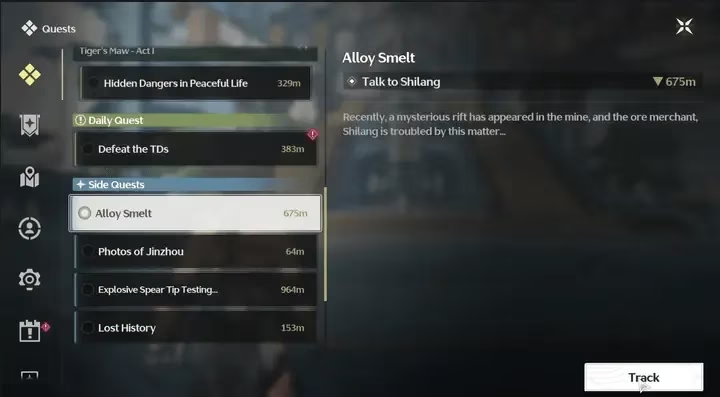
Unlocking the event was not exactly rocket science. Players needed to reach Union Level 14 and log in during the event window. Once that box was ticked, the Alloy Smelt quest popped up under Side Quests, and chasing the markers led straight into the event. It was a low barrier to entry, which made sense since the event offered trial Resonators so even newer players could jump in without having a stacked roster.
How Scoring Works
The name of the game was speed, and every second mattered. In each Rift, players had exactly two minutes to clear waves, and points were awarded based on the type of enemy taken down:
| Enemy Type | Points Per Kill |
|---|---|
| Normal mob | 50 points |
| Elite mob | 100 points |
With ten rifts in total, hitting the minimum 2,000 points per stage only added up to 20,000 points. That was enough for some baseline rewards, but the complete reward track required a whopping 90,000 points. For players doing the math, that meant an average of 9,000 points per Rift—not exactly a walk in the park. To get there, players had to crank up the difficulty and optimize their teams.

Difficulty Modifiers and Trial Characters
Each Rift came with difficulty modifiers. Players who felt confident could raise the stakes, and doing so was one of the fastest ways to pile up points. There was a trade-off, though: each difficulty step came with a recommended level increase of 10. Trial characters were capped at level 60, so once a player's own Resonators were built beyond that, they usually became the better choice.
This was a classic risk versus reward setup. A player with strong personal units could push harder and score bigger, while someone with a thinner roster might lean on trial characters to at least clear the 2,000-point threshold. The trick was knowing when to go all-in and when to play it safe.
Stage Buffs: Aero, Spectro, and Beyond
The rifts were not all built the same. Some stages came with buffs that boosted certain damage types, and the first stage was a prime example—Aero and Spectro units performed best there thanks to the stage buffs. That meant players who had built Aero or Spectro DPS characters could really shine, or they could pick trial Resonators that matched those elements.
Later stages, however, threw a curveball by not favoring any particular element. In those rifts, the smart move was to bring the strongest overall team that met or exceeded the recommended level. Element matching took a backseat, and raw damage output became the priority.
For a quick reference, players could think of it like this:
| Rift | Buff Focus | Best Approach |
|---|---|---|
| Stage 1 | Aero and Spectro damage | Use Aero/Spectro DPS or trial units matching those elements |
| Later stages | No specific element buff | Bring the strongest overall team above the recommended level |
Tips for Maximizing Points
Players who wanted the full reward track needed more than just luck. Here are a few tips that separated high scorers from the pack:
-
⏱️ Kill fast, move fast. The timer was unforgiving, so grouping enemies and using AoE skills was key.
-
💥 Prioritize elites. Elite enemies were worth double the points of normal mobs, so they were high-value targets.
-
🎯 Match the buffs. On stages with elemental buffs, using the matching element could dramatically improve clear speed.
-
🧪 Use trial Resonators wisely. They were handy if a player lacked the right element, but they capped at level 60.
-
📦 Don't settle for 2,000 per stage. The jump from 20,000 total to 90,000 total only happened through higher difficulty and stronger teams.
Rewards: Per-Rift vs Cumulative
Alloy Smelt rewarded players in two ways. First, each Rift offered rewards for reaching at least 2,000 points. That was the easy target and provided a nice baseline. Second, there was a cumulative reward track tied to the total number of points earned across all rifts.
To clean out the event shop, players needed 90,000 cumulative points. That was no small feat, especially when the 2,000-point minimums only totaled 20,000. In practice, it meant pushing each Rift to a higher difficulty, running well-built teams, and making every second of the two-minute window count. The difference between a casual run and a fully optimized run was night and day.
Final Thoughts
Alloy Smelt was a solid test of both roster depth and execution. It encouraged players to understand elemental buffs, respect difficulty modifiers, and think carefully about trial versus personal Resonators. For anyone eyeing similar events in Wuthering Waves, the same rules apply: match the stage conditions, push the difficulty when possible, and never leave points on the table. That is the recipe for cleaning out the reward track before the clock runs out.